
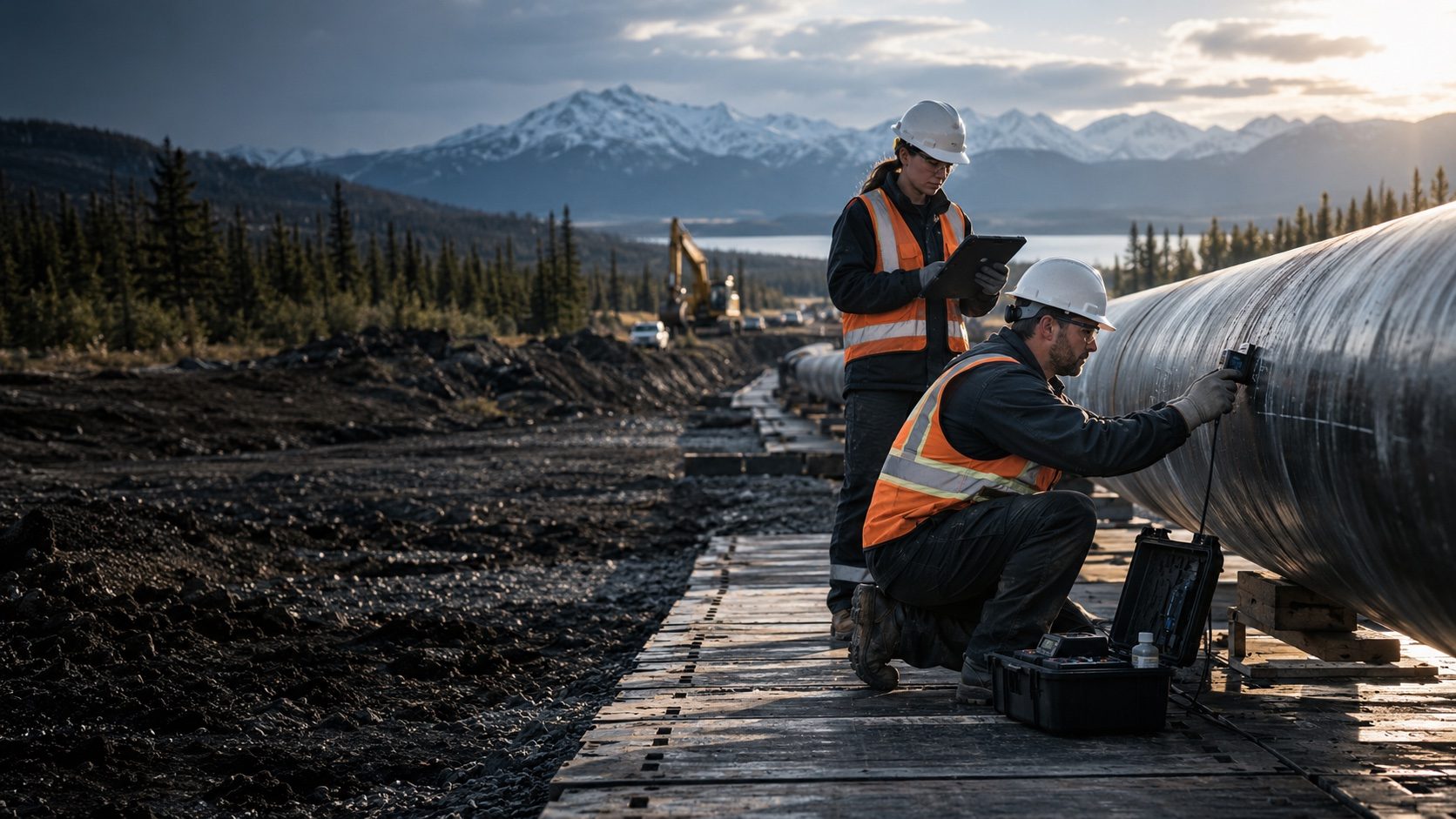
Know Which Mile Fails Next.Fix It First.
An integrity program lives in spreadsheets, ILI vendor reports and one engineer’s head. X3 Pipeline Integrity puts every covered segment, every threat, every assessment and every anomaly on one clock, ranked by risk with the reasons shown.
- Covered Segments
- Threat Matrix
- Risk Ranking
- Assessment Plan
- Repair Clocks
- MAOP Reconfirmation
- 192.917Threat identification and risk assessment
- 192.921Baseline assessment
- 192.933Remediation of anomalies
- 192.939Reassessment intervals
- 192.935Preventive and mitigative measures
- 192.624MAOP reconfirmation
- 192.607Material properties verification
- 195.452(h)Liquid repair schedules
- 195.452(j)Liquid reassessment, 68 months
- 192.710Assessments outside HCAs
- B31.8SNine threat categories
- 192.941Low-stress reassessment
The Anomaly Was in the Report. The Repair Clock Was in Nobody’s Calendar.
An ILI run comes back with hundreds of features. Each immediate, 60-day, 180-day or one-year condition starts a clock on the day you discover it, while the reassessment interval keeps running in the background. Miss one and the finding writes itself.
The data was there. Nobody had it ranked, owned and counted down.
Every Segment. Every Threat. One Ranked List.
Load your covered segments once. X3 holds the facts integrity engineers need on each one and keeps the clocks that the rule starts.
Segments
Class location, HCA or MCA, MAOP, percent SMYS, diameter, wall, seam, coating and install year on every segment.
Threats
The nine B31.8S categories on each segment: identified, ruled out with a reason, or interacting.
Risk
Likelihood times consequence, with the drivers shown, so the ranking can be defended.
Assessments
Method, date and next due by the legal limit for gas and for liquid.
Repair clocks
Discovery date, condition and the deadline it sets, counted down for every anomaly.
MAOP
Traceable, verifiable and complete records and the reconfirmation method chosen for each segment.
Stop guessing which mile is worst. Show the reason it is first.
One View of the Integrity Program.
An example of a mid-size transmission operator’s program once its segments and assessment results are in.
- Dent with metal loss at MP 27.4: immediate condition, pressure reduced, repair due (49 CFR 192.933(d)(1))
- Segment HCA-07 reassessment due within 11 months (49 CFR 192.939)
- Selective seam weld corrosion not evaluated on 1958 ERW pipe in HCA-03 (threat: manufacturing)
- MAOP reconfirmation: 14 miles without traceable records (49 CFR 192.624)
Example only. Engineering decisions stay with your qualified integrity engineers.
25 Working Screens in X3 Pipeline Integrity
- 01OverviewCovered segments, open anomalies on a clock, reassessments coming due and the highest-risk miles.
- 02Segment RegisterEvery segment with its class, HCA or MCA status, MAOP, percent SMYS, pipe and coating facts.
- 03Dynamic SegmentationThe line cut wherever wall, grade, coating, class or HCA changes, the register segments that are not uniform, and segments made from the pieces.
- 04Threat MatrixThe nine threat categories of ASME B31.8S on every covered segment, identified, ruled out or interacting.
- 05Risk RankingLikelihood of each of the nine threats and their interactions, times consequence, with every driver and data gap shown, so the worst mile is assessed first.
- 06Risk ModelTry preventive measures and shorter intervals before you spend, validate the ranking against your failure history with a sensitivity analysis, and keep the SME register.
- 07Threat ActionsWhat each identified threat requires under 192.917(e): fatigue analysis every 7 years, stable-threat test, seam assessments and similar segments to evaluate.
- 08Assessment PlanBaseline and reassessment dates by method (ILI, pressure test, direct assessment) against the legal limit.
- 09Direct AssessmentECDA, ICDA and SCCDA projects step by step: regions, two indirect tools from Corrosion, indications classified, the digs each region needs and the reassessment interval.
- 10Reassessment IntervalsThe next assessment from remaining life and growth, next to the legal maximum, using the earlier, and monitored anomalies that must be repaired first.
- 11Consequence & ClassHow each HCA, MCA and class location was identified, and the deadlines that follow: new HCAs, yearly could-affect checks and class changes.
- 12Line ViewEvery record on a system stacked by milepost like an alignment sheet, zoomable, with the coincidence finder that lines up corrosion, CP, coating and damage data for the Threat Matrix.
- 13Anomalies & RepairsEvery anomaly with its repair category and the clock that started on discovery: immediate, 60-day, 180-day, 1-year, 2-year (non-HCA gas) or monitored.
- 14MAOP ReconfirmationTraceable, verifiable and complete records per attribute, calculators for Methods 1 to 6 and progress to the 2028 and 2035 deadlines.
- 15Class 3 IM AlternativeKeep the MAOP of an eligible Class 3 segment under 192.611(a)(4): the eligibility screen, the initial requirements due in 2028 and the recurring ones on their clocks.
- 16Remaining StrengthWork out the failure pressure and safe operating pressure of a corrosion anomaly with ASME B31G, Modified B31G and RSTRENG effective area.
- 17Crack & DentCrack failure pressure by the ln-secant method with the 192.712 Charpy defaults, Paris-law fatigue life, and the B31.8 dent strain screen.
- 18ILI RunsImport the vendor feature listing, see the pipe tally by girth weld, and promote features to anomalies with their joint, weld distance and clock.
- 19Growth Between RunsMatch anomalies between two in-line inspection runs, measure growth and see how long each has before it needs repair.
- 20Dig ReportAt the dig, on a phone: measure the anomaly, record coating, repair and material tests, and close the anomaly in one report.
- 21Dig VerificationCompare what the crew measured in the dig with what the tool called, and check the tool against its stated tolerance.
- 22Material VerificationPopulations of pipe without traceable material records, the excavations each needs and the samples taken so far.
- 23PHMSA NotificationsEvery notice PHMSA must get: discovery past 180 days, pressure held over 365 days, other technology, and what was sent when.
- 24Preventive MeasuresThe preventive and mitigative measures for each covered segment, including automatic and remote shut-off valve decisions.
- 25Distribution Integrity (DIMP)The seven elements of a distribution integrity management plan, performance measures and the five-year re-evaluation.
Segment. Threat. Rank. Assess. Repair.
X3 follows the integrity cycle the rule describes, and keeps every date it starts.
- 01
Load the segments
Covered and non-covered segments with their class, HCA status and pipe facts.
- 02
Identify the threats
Work through the nine categories on each segment and record why a threat is ruled out.
- 03
Rank the risk
Score likelihood and consequence and see the drivers behind every rank.
- 04
Plan the assessments
Choose ILI, pressure test or direct assessment and see the date the rule allows.
- 05
Log what was found
Enter each anomaly with its condition and discovery date; the repair clock starts.
- 06
Close the repair
Record the repair or the pressure reduction and keep the proof with the segment.
A finding is only closed when the clock and the proof agree.
One Loop. X3 Pipeline Integrity Owns Part of “See”.
Nine products, five stages, one job each. X3 Pipeline Integrity helps answer one question for your pipeline: which mile is at risk, and why? Use it on its own, or add the products on either side of it when that job matters.
- 01
Know
What applies to every mile we operate?X3 Pipeline Compliance - 02
See
Which mile is at risk, and why?X3 Pipeline IntegrityX3 Pipeline Corrosion - 03
Control
Is the person and the control room ready for the work?X3 Pipeline QualificationX3 Pipeline Control Room - 04
Act
What has to happen in the field today?X3 Pipeline Damage PreventionX3 Pipeline FieldX3 Pipeline Emergency - 05
Prove
Could we hand an inspector the evidence in an hour?X3 Pipeline Audit
- X3 Pipeline CorrosionA corrosion threat becomes CP surveys and remediation
- X3 Pipeline Damage PreventionA third-party damage threat becomes excavation watch on that segment
- X3 Pipeline FieldA preventive measure becomes recurring field work
- X3 Pipeline AuditAssessment results and repair proof feed the IM inspection binder
X3 Keeps the Clocks. Your Engineers Make the Calls.
Integrity decisions are engineering decisions. Four things stay with your team.
Classify each anomaly
Your engineer applies the repair criteria. X3 counts the clock it sets.
Choose the method
ILI, pressure test or direct assessment is your call for each segment.
Validate the data
Vendor reports and field digs are yours to reconcile.
Sign the program
Your written IM plan and its decisions carry your name, not ours.
The Worst Mile Gets Fixed First, and You Can Show Why.
An integrity program on X3 is a ranked list with its reasons, every clock counting down and the proof filed beside the segment it belongs to.
See it.
Every threat on every covered segment, in one place.
Rank it.
The order of work, with the drivers shown.
Close it.
Every repair inside its window, with the proof.
Priced Per Mile. Start With Your Own Systems.
Create your account, describe your systems once, choose X3 Pipeline Integrity or all nine products, and run it on your own pipeline with your records saved. One sign-in opens every product you pay for.
$499 a month covers your first 100 miles of regulated pipe. Then $3 a month for each mile after that. Twelve months for the price of ten when you pay for a year. Cancel any time.
- Covered segments, threats, risk, assessments and anomaly repair clocks for gas and liquid integrity management.
- Works on its own. No other X3 product required
- Your systems, people and records, saved to your account
- Ask X3 for the regulation behind any question
X3 Pipeline Integrity and the other eight, one sign-in, one bill. $1,999 a month covers your first 100 miles, then $12 a month for each mile after that.
- Every product from knowing what applies to proving it
- Work flows from one product to the next
- The command center shows leaders what needs attention
- Costs about the same as four products bought one at a time
$1,249 a month for X3 Pipeline Integrity
$4,999 a month for all nine products
Yearly: $12,490 or $49,990
| Miles | X3 Pipeline Integrity | All nine products |
|---|---|---|
| 50 | $499 | $1,999 |
| 250 | $949 | $3,799 |
| 500 | $1,699 | $6,799 |
| 1,000 | $3,199 | $12,799 |
| 2,500 | $7,699 | $30,799 |
Why per mile. Pipeline work grows with miles of pipe: patrols, test stations, valves, leak surveys and assessments all scale with the system. So X3 Pipeline is priced per regulated mile. Every product has a monthly minimum that covers your first 100 miles, because every operator carries the same fixed work whatever its size: written procedures, an OQ program, an emergency plan and annual reports. Each mile after that adds a small amount. All nine products cost about four times one, so running the whole loop is the better deal, and paying for a year gets you twelve months for the price of ten.
What counts as a regulated mile
- Gas distribution
- Miles of main, as on your PHMSA annual report (Form PHMSA F 7100.1-1). Service lines are not counted.
- Gas transmission and gathering
- The regulated miles on your last PHMSA annual report (Form PHMSA F 7100.2-1, or F 7100.2-3 for Type R gathering).
- Hazardous liquid and CO2
- The miles on your last PHMSA annual report (Form PHMSA F 7000-1.1), every commodity added together.
- Master meter and small LPG systems
- These systems file no annual report, so count the miles of main you operate.
- LNG plants, storage fields and tank farms
- Facilities do not fit a per-mile price. We set up a quote with you.
Small systems: talk to us. Under 100 miles, a small town distribution system, or a master meter system? Write to [email protected] and we will work out a plan that fits the size of your system. Public utilities can also pay by invoice.
Prices in US dollars. Subscriptions renew each month or year until cancelled.
Questions Operators Ask About X3 Pipeline Integrity.
Have one that is not here? Ask X3, or write to us and a person will answer.
Does it work for both gas and hazardous liquid?
Does X3 classify anomalies for us?
Can we load ILI results?
Do I have to buy all nine products?
How do I start?
How does pricing work?
Can my whole team use it?
Can I keep documents and photos with the records?
Does it work in the field without a signal?
Do the products work together?
Know Which Mile Is Next, and Prove Why It Was First.
Create your account, load your covered segments and see your integrity program on one clock.